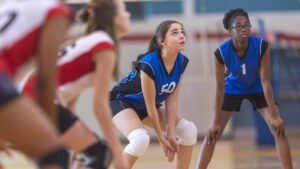
A strong vertical jump is a game-changer in volleyball. Whether you’re spiking the ball past defenders or blocking an opponent’s shot, the ability to jump higher gives you a significant edge. It allows players to execute powerful attacks, defend effectively at the net, and increase their overall presence on the court. Fortunately, improving your vertical leap isn’t just about genetics—it’s about proper training, technique, and consistency. By following a structured program that combines strength training, plyometrics, flexibility work, and mental preparation, any volleyball player can significantly enhance their jump height and overall game performance.
In this article, we’ll break down the best strategies to help you increase your vertical jump for better spikes and blocks.
The Science Behind a Higher Jump
Jumping higher requires explosive power, strength, and proper mechanics. This means optimizing various physical and technical aspects to maximize efficiency and height. It’s not just about having strong legs or a good jump technique—it’s about the synchronization of multiple body systems working together. Key elements include lower-body strength to generate force, core stability to maintain balance, flexibility to allow full range of motion, and proper coordination to execute an efficient jump. Additionally, incorporating speed and agility training, as well as sufficient rest and recovery, ensures that your body can perform explosive jumps repeatedly without the risk of injury or fatigue. Developing these aspects systematically will result in measurable improvements in vertical leap and overall athletic performance.
- Leg Strength – Strong quadriceps, hamstrings, and calves generate power for an explosive takeoff.
- Core Stability – A strong core enhances balance and control, allowing for a more efficient jump.
- Flexibility & Mobility – Greater range of motion allows for a deeper squat before takeoff.
- Neuromuscular Coordination – Your body must efficiently recruit muscle fibers for maximum force production.
- Proper Technique – Utilizing the right form ensures you maximize your jump potential.
- Speed & Agility – Quick, reactive movement contributes to explosive jump performance.
- Recovery & Rest – Proper rest allows muscles to rebuild and strengthen for peak performance.
Strength Training for Higher Jumps
Building lower-body strength is essential for increasing your jump height. Stronger legs allow you to generate more force with each jump, leading to higher leaps and better on-court performance. Developing explosive power in your quadriceps, hamstrings, glutes, and calves is key to maximizing vertical height. In addition to strength, improving muscular endurance and stability will help sustain powerful jumps throughout a match. Incorporate these strength-training exercises into your routine to build the necessary power and resilience for higher jumps and improved overall athleticism.
1. Squats (Back & Front)
- Develop overall lower-body strength.
- Improve explosiveness when transitioning from a deep squat to a jump.
- Perform 3-4 sets of 6-10 reps with moderate to heavy weights.
2. Deadlifts
- Strengthen hamstrings, glutes, and lower back.
- Enhance overall power for explosive jumps.
- Perform 3-4 sets of 5-8 reps.
3. Bulgarian Split Squats
- Improve unilateral leg strength and balance.
- Help prevent imbalances that could lead to injuries.
- Perform 3 sets of 8-12 reps per leg.
4. Calf Raises
- Strengthen the calves for improved push-off power.
- Perform 4 sets of 12-15 reps.
5. Step-Ups with Weights
- Enhance single-leg explosiveness, essential for jumping.
- Perform 3 sets of 10 reps per leg.
6. Nordic Hamstring Curls
- Strengthen hamstrings to support knee stability.
- Perform 3 sets of 8 reps.
7. Hip Thrusts
- Develop glute power for explosive jumps.
- Perform 3 sets of 10 reps.
8. Sled Pushes
- Build overall leg strength and endurance.
- Perform 3 sets of 20 meters.
Plyometrics for Explosiveness
Plyometric exercises specifically target fast-twitch muscle fibers, which are responsible for quick, explosive movements like jumping. These exercises improve neuromuscular coordination, allowing your muscles to generate force more efficiently and react more swiftly in game situations. By incorporating dynamic movements such as depth jumps, tuck jumps, and lateral bounds, athletes can enhance their ability to rapidly produce power, leading to higher jumps, quicker takeoff, and improved directional control on the court. Additionally, plyometrics help refine muscle memory, ensuring that explosive movements become more natural and require less conscious effort. Consistently practicing plyometrics not only increases jump height but also improves agility, reaction time, balance, and overall athletic performance. When combined with proper recovery and progressive overload, plyometric training can lead to significant improvements in an athlete’s vertical leap and on-court movement efficiency.
1. Box Jumps
- Develop explosive power and improve coordination.
- Perform 3 sets of 8-10 reps.
2. Depth Jumps
- Enhance reactive strength by utilizing stretch-shortening cycles.
- Perform 3 sets of 5 reps.
3. Jump Squats
- Train leg power and endurance.
- Perform 3 sets of 10 reps.
4. Broad Jumps
- Develop full-body power and explosive strength.
- Perform 3 sets of 8 reps.
5. Lateral Bounds
- Improve lateral explosiveness, crucial for quick volleyball movements.
- Perform 3 sets of 12 reps.
6. Single-Leg Hops
- Improve balance, coordination, and unilateral power.
- Perform 3 sets of 10 reps per leg.
7. Tuck Jumps
- Train explosive knee drive for higher jumps.
- Perform 3 sets of 8 reps.
8. Resistance Band Jumps
- Improve jump endurance and power.
- Perform 3 sets of 12 reps.
Core & Mobility Work for Stability and Flexibility
A strong core and good mobility are essential for executing proper jump mechanics, maintaining body control in the air, and preventing injuries. Core stability allows athletes to transfer power efficiently from the lower body to the upper body, ensuring optimal coordination and balance. Mobility, particularly in the hips, ankles, and thoracic spine, enables a greater range of motion, reducing restrictions that could hinder jump efficiency. By focusing on core engagement and flexibility, volleyball players can enhance their overall athletic performance, improve landing mechanics, and reduce strain on joints and muscles.
1. Planks & Side Planks
- Strengthen the core for better stability mid-air.
- Hold each plank for 45-60 seconds.
2. Hanging Leg Raises
- Strengthen hip flexors and lower abs, contributing to knee drive in jumping.
- Perform 3 sets of 12 reps.
3. Hip Flexor & Hamstring Stretches
- Improve flexibility to allow for a greater range of motion.
- Hold each stretch for 30-45 seconds.
4. Medicine Ball Twists
- Improve rotational strength to stabilize the jump landing.
- Perform 3 sets of 15 reps.
5. Resistance Band Hip Flexion
- Strengthen hip flexors to enhance knee drive.
- Perform 3 sets of 12 reps per leg.
Jump Technique and Form
Even with strength and power, an improper jumping technique can significantly limit your jump height and overall effectiveness on the court. A well-executed jump involves a combination of optimal body positioning, coordinated arm movement, proper foot placement, and controlled landing mechanics. Neglecting any of these aspects can result in wasted energy, inefficient jump execution, and a higher risk of injury. Follow these key technique tips to ensure that you are maximizing every jump and improving your ability to perform high-impact plays like spikes and blocks with precision and control.
- Arm Swing: Use your arms to generate upward momentum.
- Proper Takeoff Position: Keep knees slightly bent, push off with toes, and engage the glutes.
- Land Softly: Absorb the impact to prevent injuries.
- Explosive Knee Drive: Bring knees up as you jump to maximize height.
Sample Weekly Jump Training Plan
| Day | Workout Focus | Key Exercises |
|---|---|---|
| Monday | Strength Training | Squats, Deadlifts, Calf Raises |
| Tuesday | Plyometrics | Box Jumps, Broad Jumps, Jump Squats |
| Wednesday | Mobility & Core | Planks, Hanging Leg Raises, Stretching |
| Thursday | Strength Training | Bulgarian Split Squats, Calf Raises, Step-Ups |
| Friday | Plyometrics | Depth Jumps, Jump Squats, Broad Jumps |
| Saturday | Active Recovery | Yoga, Foam Rolling, Light Stretching |
| Sunday | Rest | – |
Mental Conditioning for a Better Jump
Your mindset plays a crucial role in athletic performance, particularly when it comes to improving your vertical jump. Mental conditioning can enhance focus, resilience, and confidence, enabling you to push past physical and psychological barriers. Developing a strong mental approach helps in overcoming plateaus, staying motivated during rigorous training, and optimizing performance under pressure. Use these mental techniques to sharpen your focus, build consistency, and elevate your game to new heights:
- Visualization: Picture yourself executing the perfect jump.
- Focus Drills: Practice maintaining concentration before each jump.
- Breath Control: Improve endurance and explosive power by controlling breathing.
- Goal Setting: Establish incremental jump height goals.
Conclusion
Improving your vertical jump requires a combination of strength training, plyometrics, mobility work, proper nutrition, and mental conditioning. Each of these elements plays a critical role in developing the explosive power and endurance necessary for high-performance jumping. Strength training builds the foundation for power, plyometrics enhances fast-twitch muscle response, mobility work ensures flexibility and range of motion, nutrition provides the necessary fuel, and mental conditioning fosters confidence and consistency. By following this structured approach, you’ll see significant gains in your ability to spike and block more effectively, leading to better overall performance on the court.
Commit to consistency, track your progress meticulously, and continuously refine your technique. By focusing on steady improvements and pushing your limits with each session, you’ll develop the explosive power and confidence needed to dominate the net with higher, more powerful jumps. Stay dedicated, embrace the process, and watch as your performance reaches new heights.